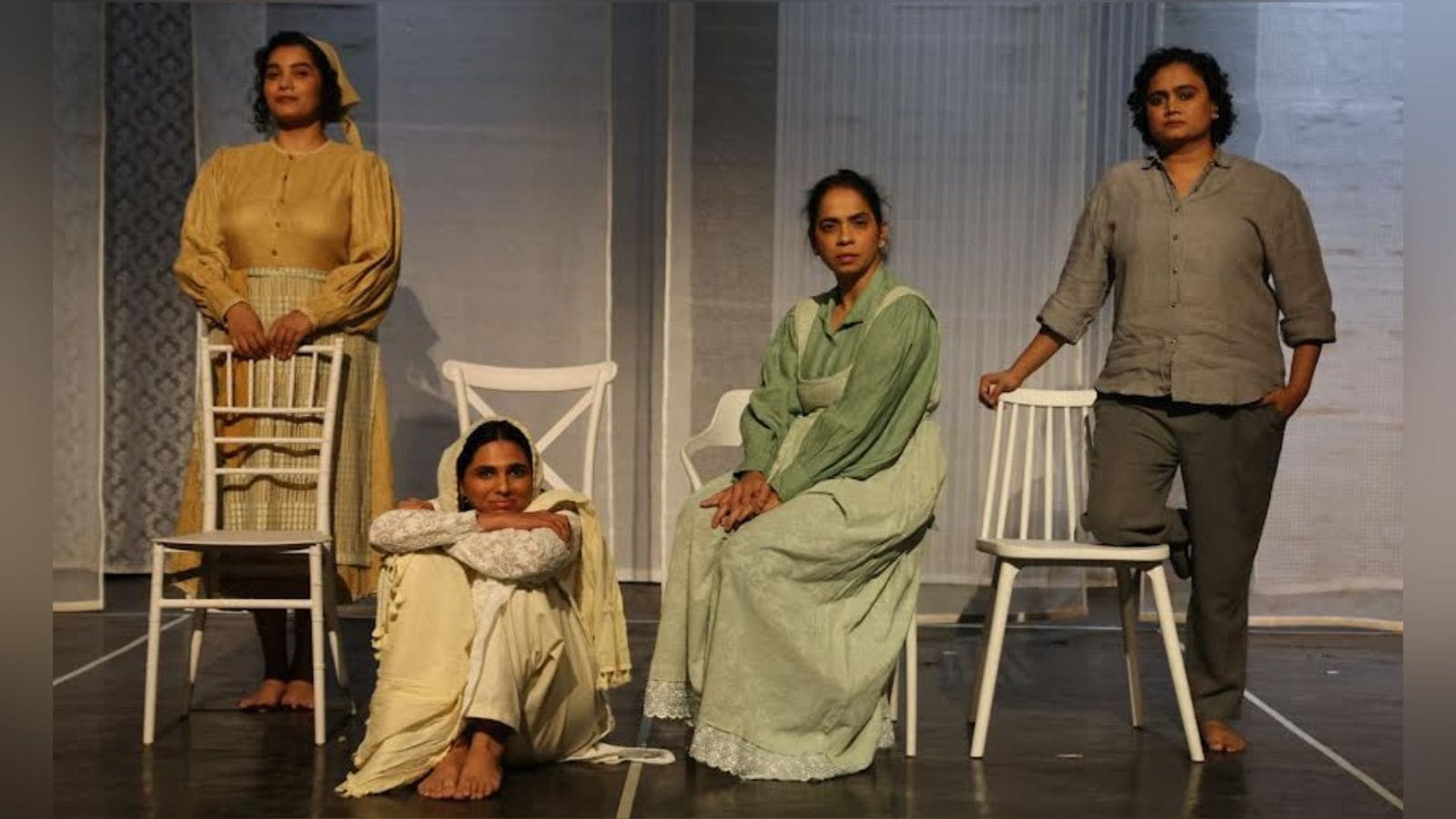
She is one of the most enigmatic characters of Indian literature, the sister-in-law of Rabindranath Tagore and his muse, close friend, confidante and quiet strength. Her life, cut short by suicide in April 1884, is wrapped in secrecy and curiosity, with a number of artists and writers imagining what could have been. When Meghna Roy Choudhury set out to tell the story of Kadambari Devi in the play, Kadambari, it was an act of courage.
Roy Choudhury, a probashi bangali or a Bengali who lives outside Bengal, was tackling not only a revered personality of the culture but was doing it in the Bengali language, which she had not studied in, and with actors who were, except one, not Bengalis. Kadambari, the play, has won over audiences since it premiered in Pune earlier this year, and has been staged at important venues in Mumbai, Delhi and Bengaluru. Now, it will meet its greatest test – Kadambari has been selected for the 8th National Theatre Festival, which is being held in Kolkata from January 4 to 12. The theatre festival, under the aegis of the West Bengal government, counts Chief Minister Mamata Banerjee as a patron. Kadambari will be staged at Madhusudan Mancha on January 10.
“We did shows where people from Shantiniketan had come, so I am confident in going to Minerva. I am still very, very nervous, and I hope that the audience has an open mind,” says Roy Choudhury. The play is a lyrical, multi-dimensional work, led by the astute Ipshita Chakraborty as Kadambari Devi. “The actors have put in a lot of effort into understanding a culture and making it their own,” adds Roy Choudhury.
Kadambari. (Express Photo)
This year, four plays from Pune have been selected for the 8th National Theatre Festival, organised by the Minerva Natyasanskriti Charchakendra.
Suyog Deshpande’s Via Savargaon Khurd is an adaptation of a novel by Dinkar Dabhade, which revolves around elections in the Savargaon village. Each character steps before the audience and introduces themselves before speaking. The play comprises 19 monologues that tackle issues, ranging from patriarchy to mother-son dysfunctional relationships to the gram devta. “While we have stayed true to the nature of the text, the play also brings in contemporary issues, such as the Ladki Bahen scheme,” says Deshpande. Kolkata audiences will watch the play on January 9 at Girish Manch.
Via Savargaon Khurd. (Express Photo)
What is concerning him is that the play is in the rural Varhadi language, spoken in the Vidarbha region, rather than the urban Marathi of cities like Pune. “We have been told that there are many Marathi-speaking people in Kolkata. At the same time, we are trying to introduce a few lines in Bengali for the actors to engage the audiences,” says Deshpande. For the most part, the director is leaving the play untouched. “I am eager to see the interaction between the audiences of Kolkata with a play in a rural language from Maharashtra,” says the director.
Thakishi Samvaad, which is closing in on its 50th show a year-and-half after it premiered, is yet another monologue-heavy Marathi play with powerful themes. Written by Satish Alekar, directed by Anupam Barve and with Girija Oak and Suvrat Joshi in the cast, this satire explores themes ranging from loneliness and the changing political climate, through a conversation between an elderly man and a thaki doll.
Story continues below this ad
Thakishi Samvaad. (Express Photo)
“It is a great honour to get selected at any festival because, these days, there’s such a massive volume of plays being produced, especially around Pune and Mumbai. Getting selected for a state-run festival is a special honour,” says Barve. He adds that the subtitles will accompany the play in Kolkata. The play will be staged at Girish Mancha on January 6.
Directorial debut
Something Like Truth, by playwright Shanta Gokhale, is the first directorial work by Parna Pethe. It will be staged at Madhusudan Mancha on January 6. “It is an exploration of truth, freedom and justice through four monologues by women that span 19th century France, early 2000s India, and post-war Sri Lanka. The women’s stories are intimate, political and deeply human,” says Pethe, about the critically-acclaimed play. “Whenever we talk about Indian theatre, the relationship of history and contemporary-ness between Marathi and Bengali theatre is always talked about. We are excited to take a play that took shape in Maharashtra to the theatre makers and theatre lovers of Kolkata,” says Pethe.
Expand
Dipanita Nath is a Senior Assistant Editor at The Indian Express, based in Pune. She is a versatile journalist with a deep interest in the intersection of culture, sustainability, and urban life.
Professional Background
Experience: Before joining The Indian Express, she worked with other major news organizations including Hindustan Times, The Times of India, and Mint.
Core Specializations: She is widely recognized for her coverage of the climate crisis, theatre and performing arts, heritage conservation, and the startup ecosystem (often through her “Pune Inc” series).
Storytelling Focus: Her work often unearths “hidden stories” of Pune—focusing on historical institutes, local traditions, and the personal journeys of social innovators.
Recent Notable Articles (December 2025)
Her recent reporting highlights Pune’s cultural pulse and the environmental challenges facing the city during the winter season:
1. Climate & Environment
“Pune shivers on coldest morning of the season; minimum temperature plunges to 6.9°C” (Dec 20, 2025): Reporting on the record-breaking cold wave in Pune and the IMD’s forecast for the week.
“How a heritage tree-mapping event at Ganeshkhind Garden highlights rising interest in Pune’s green legacy” (Dec 20, 2025): Covering a citizen-led initiative where Gen Z and millennials gathered to document and protect ancient trees at a Biodiversity Heritage Site.
“Right to breathe: Landmark NGT order directs PMC to frame norms for pollution from construction sites” (Dec 8, 2025): Reporting on a significant legal victory for residents fighting dust and air pollution in urban neighborhoods like Baner.
2. “Hidden Stories” & Heritage
“Inside Pune library that’s nourished minds of entrepreneurs for 17 years” (Dec 21, 2025): A feature on the Venture Center Library, detailing how a collection of 3,500 specialized books helps tech startups navigate the product life cycle.
“Before he died, Ram Sutar gave Pune a lasting gift” (Dec 18, 2025): A tribute to the legendary sculptor Ram Sutar (creator of the Statue of Unity), focusing on his local works like the Chhatrapati Shivaji statue at Pune airport.
“The Pune institute where MA Jinnah was once chief guest” (Dec 6, 2025): An archival exploration of the College of Agriculture, established in 1907, and its historical role in India’s freedom struggle.
3. Arts, Theatre & “Pune Inc”
“Satyajit Ray, Ritwik Ghatak were not rivals but close friends, says veteran filmmaker” (Dec 17, 2025): A deep-dive interview ahead of the Pune International Film Festival (PIFF) exploring the camaraderie between legends of Indian cinema.
“Meet the Pune entrepreneur helping women build and scale businesses” (Dec 16, 2025): Part of her “Pune Inc” series, profiling Nikita Vora’s efforts to empower female-led startups.
“How women drone pilots in rural Maharashtra are cultivating a green habit” (Dec 12, 2025): Exploring how technology is being used by women in agriculture to reduce chemical use and labor.
Signature Style
Dipanita Nath is known for intellectual curiosity and a narrative-driven approach. Whether she is writing about a 110-year-old eatery or the intricacies of the climate crisis, she focuses on the human element and the historical context. Her columns are often a blend of reportage and cultural commentary, making them a staple for readers interested in the “soul” of Pune.
X (Twitter): @dipanitanath … Read More
Click here to join Express Pune WhatsApp channel and get a curated list of our stories
© The Indian Express Pvt Ltd