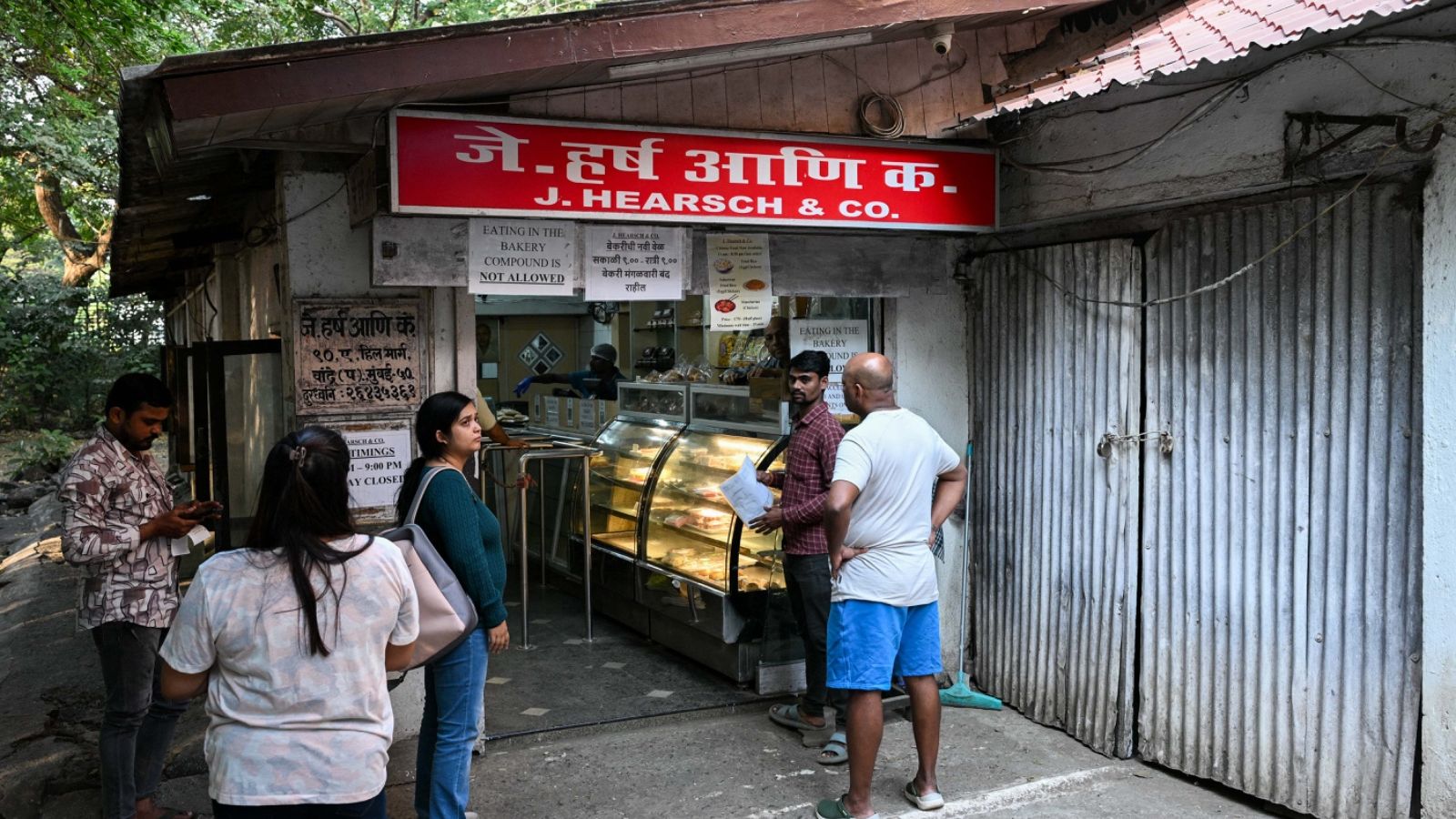
Inside Bandra’s century-old bakery J Hearsch & Co., history wafts through the walls as thick as the smell of freshly baked buns. The bakery has survived world wars and quietly watched neighbourhoods around it transform, while changing hands multiple times— without ever losing its identity.
J Hearsch & Co isn’t easily found or accessible. In fact, it’s a spot you really need to know how to find. Tucked inside a residential compound on Hill Road, right next to Holy Family Hospital, the bakery reveals itself only to those in the know.
Tracing its roots to pre–World War, J Hearsch & Co is a legend of sorts. People from across Mumbai queue up outside the bakery for its burgers, wraps and puffs that have attained cult status over the decades. Interestingly, no one from J Hearsch’s lineage mans the bakery today.
Who is J Hearsch?
J Hearsch, or Jacob Hearsch, the man whose name is on the bakery, was a German man who opened the establishment sometime in the early 1900s, if not earlier. During the Second World War, when Britain declared war on Germany, all Germans residing in India (then ruled by the British) decided to flee the country, and among them was Jacob Hearsch.
Before leaving India, Hearsch began looking for a buyer for his pav bakery. That buyer turned out to be Sabina Fernandes.
“She purchased the bakery in 1939 when Jacob wished to leave India,” shared her grandson Fredrick Fernandes, 81, known as Freddy in the neighbourhood. “She asked him if she could continue with the name, and he agreed.”
Sabina Fernandes ran the bakery for a few years before passing away in the mid 1940s. Her daughter-in-law, Celine Fernandes, then took it over until the late 1960s. “But because nobody in the family was willing to take over, we eventually decided to give it to two partners,” Fredrick shared.
Story continues below this ad
The partnership eventually dissolved, leaving the bakery with one owner for a short while before it was put up for lease yet again.
J Hearsch & Co is famous for its burgers, rolls and puffs. More recently they launched Korean cream cheese buns and bombolinis. (Express photo by Sankhadeep Banerjee)
A fresh lease on life
That was when the Dsa family entered the picture. A pherivala by profession, Michael Dsa would pile ladi pav onto his bicycle and distribute them door to door across the city. When he learnt the bakery was available, he reached out to the owners.
“We had the least experience and resources, and yet they chose us,” said his son Melwyn Dsa, 67, who now runs the bakery with his brother Stephen, 65, and daughter Megal, 30 — both of whom have formal culinary training.
“At the time, it was a tin-shed pav bakery,” Melwyn recalled. “Everything was manual. It ran round the clock, all through the year. The effort was enormous for the profit it made.”
Story continues below this ad
Melwyn began working at the bakery at the age of eight, often putting in 16-hour days. “I worked without break for 10 to 15 years,” he said, underlining the physical demands the business placed on the family.
A foodie at heart, Melwyn slowly began shifting the bakery’s focus. “We started adding food options and gradually made it all about food. We stopped making pav completely sometime in the 1990s,” he said. They began with minced rolls, followed by puffs, and then expanded into other savoury items.
Their now-iconic burger was introduced sometime in the early 1980s. “I must have eaten a burger somewhere,” Melwyn recalled, adding that Bandra was very different back then. “There were only a handful of restaurants — Lucky, Central Hindu Hotel (now Balaji), and a few others. People were used to patties and hot dogs. No one had heard of burgers… Very few attempted it, but we popularised it by keeping it affordable,” he said. The response was slow at first, but the recipe evolved and eventually found its footing. Today, the chicken burger — layered with mayo, onions, patty, tomato ketchup, tomato slices and cheese — is the bakery’s best seller. “It’s very simple, but extremely popular,” Melwyn said.
Over the years, Melwyn also upgraded the bakery’s technology, introducing newer machines as they became available and automating several processes. He hired more experienced, ambitious staff who also wanted to grow with the business.
Story continues below this ad
The result: J Hearsch & Co entered what Melwyn calls its golden phase.
Melwyn Dsa now mans the bakery with his brother Stephen and daughter Megal. (Express photo by Sankhadeep Banerjee)
What makes J Hearsch iconic?
When the Dsa family took over, Melwyn admits the bakery wasn’t particularly popular. Over time, however, it built a loyal following. Today, queues often stretch up to the gate, especially on weekends.
“We have never advertised,” Melwyn said. “We’ve let word of mouth speak.” After a pause, he added, “Maybe it’s the freshness. We don’t bulk-produce. As items start running out, we make fresh batches. Our pricing is reasonable, and the taste matters.”
Many of the recipes, he said, are in-house and trace back to his mother Lucy, who introduced mutton rolls and minced rolls. “We built on that foundation with burgers and other items.”
Story continues below this ad
In September last year, the bakery cut its menu down by half, reducing the Chinese section to just three items. “The goal is that nothing should remain at the end of the day,” Melwyn explained. “If we’re making 100 items and 15 are left over, that shouldn’t happen. Losses shouldn’t eat into our profits.” The reduced menu, he added, also helps control the crowd, which had become increasingly difficult to manage.
Interestingly, at J Hearsch & Co, a strict queue is followed. A staff member hands out menus while customers wait outside. Only one person is allowed inside at a time to place an order, after which they step out and wait for it to be packed. Despite being located inside a compound with ample open space, customers are not allowed to eat on the premises.
The queue system was introduced during the Covid-19 pandemic and has remained since. “If the queue gets too long, we take two orders at a time,” Melwyn said. “For packing, we add more staff. My brother and daughter also step in when needed.” This hands-on approach is also why the bakery is not on delivery platforms. “Our focus is on those who come to the counter,” he said.
Among the newer additions to the menu are Korean cream cheese buns and bombolinis, both introduced as recently as September. “Korean cream cheese buns have an intense garlicky flavour and not everyone likes them,” Melwyn said. “But the response has been better than we expected. With bombolinis, we knew the demand would be good.”
Story continues below this ad
What lies ahead
The business, Melwyn admits, is currently thriving. “I’ve given my whole life to this,” he said. “What makes me happy is the success of the bakery.” When asked about expansion plans, he shared: “There’s no next generation ready to take over. They all have good jobs and are well settled. Not 24×7 but even today, the bakery demands constant physical presence. You can’t leave it entirely to your staff.”
Fredrick Fernandes also shared that its future at the location also remains uncertain.
“These two brothers are the architects of the bakery’s renown,” said Fredrick Fernandes. “They revamped everything and maintained the quality. The bakery became so popular that some years ago, Jacob Hearsch’s granddaughters even visited to see it for themselves.”
However, he added that the Dsa family are tenants. “A builder has purchased five of the six shares of this property. The matter is in court, but once it settles, they will have to vacate.” While it’s unclear how long the legal process will take, Fredrick estimates it may not be more than two years.
Story continues below this ad
For Bandra’s loyal patrons, it may be time to savour these familiar flavours a little more consciously, while they still can.