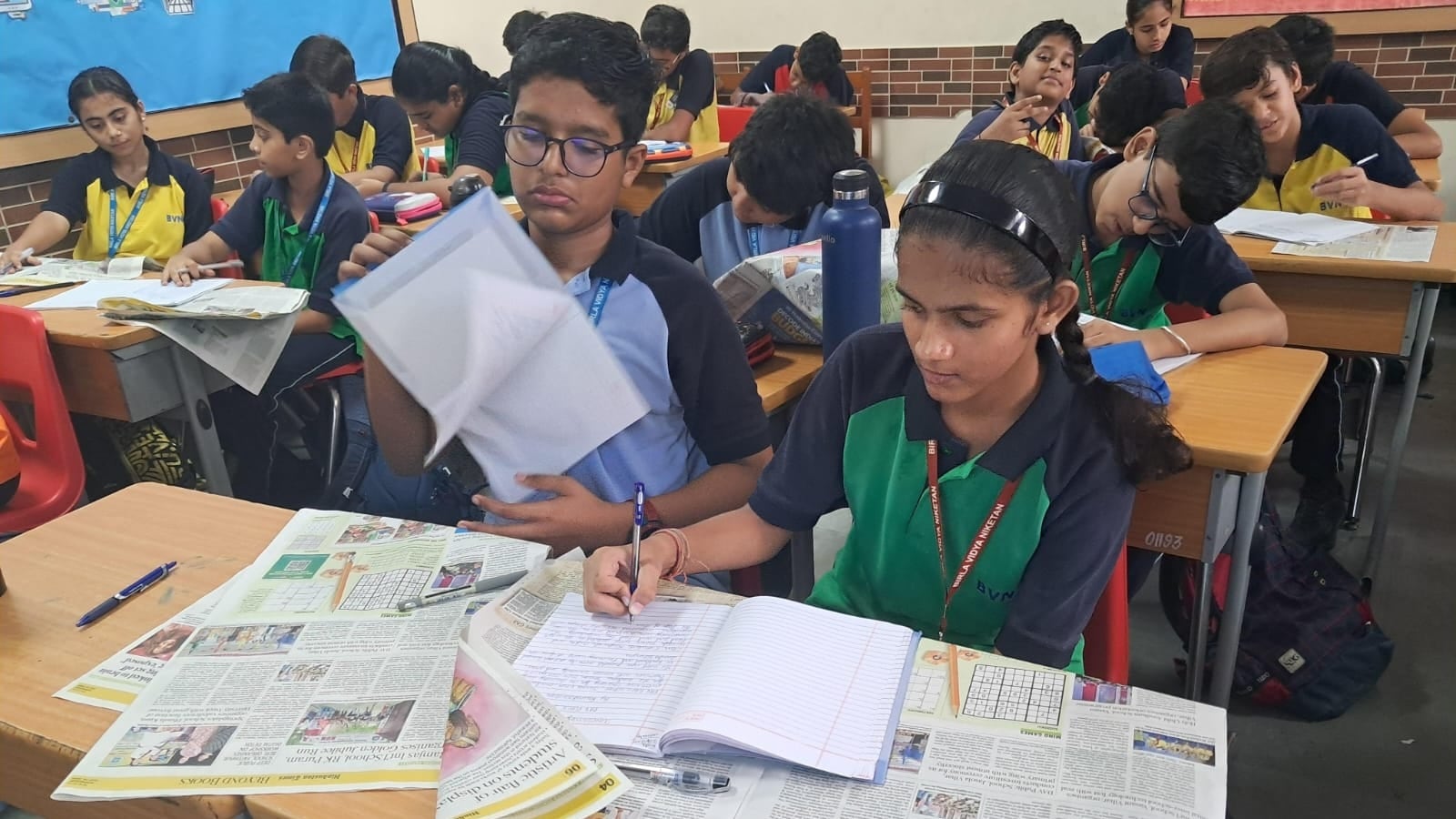
It is the DEAR period at Birla Vidya Niketan in Delhi’s Pushp Vihar — Drop Everything and Read. For 45 minutes, before formal classes begin, students sit with slim, student-edition newspapers spread across their desks.
Two children share a copy. Teachers move through the classroom, pausing at a headline, explaining a word, asking why a story matters.
A teacher then asks what they call a “chocolate question”, about a current event. The student who answers correctly earns a chocolate and their name is announced across the school.
“This is all to promote current affairs and general knowledge,” says Principal Minakshi Kushwaha. “In my school, current affairs are taken very seriously.”
In the last few weeks, the Uttar Pradesh and Rajasthan governments mandated newspaper reading in schools to promote a “strong reading culture”. In an order issued on December 23 last year, the UP govt introduced a dedicated 10-minute “news reading” slot during daily morning assemblies for students in all basic and secondary schools to “curb excessive screen time”.
The Indian Express speaks to private and government schools in Delhi to capture how the culture has been embraced in classrooms for decades.
A learning guide
At The Indian School in Sadiq Nagar, newspapers were introduced for classes 3 to 12 as a morning routine.
Story continues below this ad
“During the zero period, the teacher discusses things with children related to the newspaper,” says Principal Tania Joshi. “It’s not only for knowledge or to encourage reading, but also to help children connect concepts.”
English lessons unfold through newsprint. Senior students practise report writing and article writing using real stories, while younger children circle nouns and adjectives, solve crosswords, and learn new words. Editorials become discussion points in classrooms.
The school subscribes to school editions of newspapers.
“It’s the cheapest resource, not only for the teacher but also for the child. I wouldn’t say it’s mandatory, it’s a habit we’ve inculcated,” Joshi says. One that, she estimates, has been in place for at least a decade.
“But when it comes to screen time, we have not held any survey particularly to see if there has been a reduction. All I can say is I’ve noticed children turning to more books in their free period as compared to before we started the newspaper reading exercise.”
Story continues below this ad
At Birla Vidya Niketan in Pushp Vihar, Classes 4 to 12 read the student editions. The main newspapers, Principal Kushwaha says, carry too much crime for younger readers. “We don’t get the main newspaper. The students’ edition is very well designed for children.”
Asked whether she sees a measurable link between newspaper reading and reduced screen time, Kushwaha adds: “Frankly speaking, I don’t know.”
In Delhi’s government schools, teachers say reading the paper is not mandatory.
“There isn’t any such regulation,” says a government school teacher in South Delhi who teaches Mathematics to senior classes. “But libraries do have newspapers and children are encouraged to read them. It’s not made mandatory or a habit in our school.”
Story continues below this ad
The teacher adds that government schools used to subscribe to junior editions but they were discontinued many years ago.
Ajay Kumar Choubey, principal of Sarvodaya Bal Vidyalaya near Rouse Avenue, says: “Earlier, government schools used to subscribe to newspapers. That practice stopped when funding dried up.”
Now, one student, selected through the house system, reads headlines from the main newspaper during the assembly and explains a few stories in detail. The school library stocks newspapers, magazines, and journals.
“Reading newspapers will definitely reduce the impact of screen time,” he says. “It has not been made mandatory by the state, but we encourage it. It’s a very powerful instrument.”
Expert speak
Story continues below this ad
Education experts, however, are wary of the leap from encouragement to evidence.
“Reading newspapers every day is not a bad thing at all,” says Punam Batra, professor of education and former faculty at Delhi University’s Central Institute of Education (CIE).
But the claim that it will automatically reduce screen time is “a tall order”. “There is no research in our context or otherwise that shows reading a physical newspaper reduces addiction to screens,” she says.
Batra is also sceptical of the assumption that newspapers are neutral pedagogical tools. “Newspapers and other media have largely been captured by the state,” she adds.
Story continues below this ad
A more meaningful intervention, she says, would be to shift children from consumers of news to producers. At the CIE Basic School, a DU-run elementary school, children once created weekly newspapers about their surroundings, guided by teachers. Similar models exist in community journalism projects and in alternative schools in Bengaluru, she adds.
This, Batra says, helps children learn to distinguish fact from opinion and propaganda.
Latika Gupta, a faculty member at Delhi University’s Department of Education, says that while newspaper reading should be encouraged in schools, it cannot be projected as a cure for children’s screen dependence. “A child can always come back home and turn to a screen to access more information,” she tells The Indian Express.
At the same time, Gupta notes that reading from print allows for deeper engagement than reading from a device. A physical newspaper, she says, requires children to slow down and read patiently, which often helps them grasp content better than scrolling through information on a screen.
Story continues below this ad
Gupta also points out that the idea of newspapers in classrooms is not new. “Since the 1970s, the NCERT has been suggesting that schools keep two copies of newspapers for a set of students in each classroom to cultivate the reading habit.”
Until 2018, she says, Delhi government schools followed this practice. “But with the aggressive push towards smart classrooms, this initiative… now exists in a diluted form.”
Professor R Govinda, former Vice-Chancellor of the National University for Education Planning and Administration, who was instrumental in drafting the Right to Education Act, also says evidence linking newspaper reading to reduced screen time is minimal.
He dismisses concerns that newspapers would necessarily politicise children. “Children will read what interests them. A Class 12 student, an eighth grader, and a fourth grader approach newspapers very differently. Few young children are drawn to political news in the first place,” he adds.
Doctors, however, share a more positive take.
Story continues below this ad
Dr Bhavna Barmi, an eminent senior clinical and child psychologist and founder of Happiness Studio, says structured reading routines in schools can play a meaningful role in reducing children’s overall screen time, particularly outside school hours.
“When reading is built into the school day, it acts as a healthy habit replacement, occupying time that might otherwise be spent on screens. Reading demands sustained attention and cognitive engagement, which strengthens attention span and makes passive screen consumption less appealing,” she says.
“Over time, this also supports better self-regulation — children who develop stronger executive functioning are more capable of setting limits on their own screen use. School-based reading routines often spill over into home environments, encouraging families to reinforce reading after school and, thereby, reducing unstructured screen time. Replacing screens with reading, especially in the evening, can also improve sleep patterns and reduce late-night screen dependence,” she adds.
The American Academy of Pediatrics (AAP), one of the most influential bodies issuing peer-reviewed guidelines, recommends limiting recreational screen time for young children. It actively promotes shared reading practices to build healthy literacy foundations and enrich cognitive development, backed by studies showing greater language and engagement benefits from print reading compared with electronic media.
Dr Kamna Chhibber, Clinical Psychologist and Director of the Mental Health Programme at Fortis Healthcare, Gurgaon, said reading works as an effective habit replacement in an environment where screens are the default form of engagement.
“When you introduce structured activities like reading, you are automatically reducing the time available for screens — it’s simple logic. Reading, especially from a physical book or newspaper, is far less stimulating than digital media. It reduces distractions, improves attention and focus, and trains the brain to engage with neutral, low-stimulus content. This is important because many children today struggle with focus because they are constantly exposed to high levels of stimulation on screens,” she says.