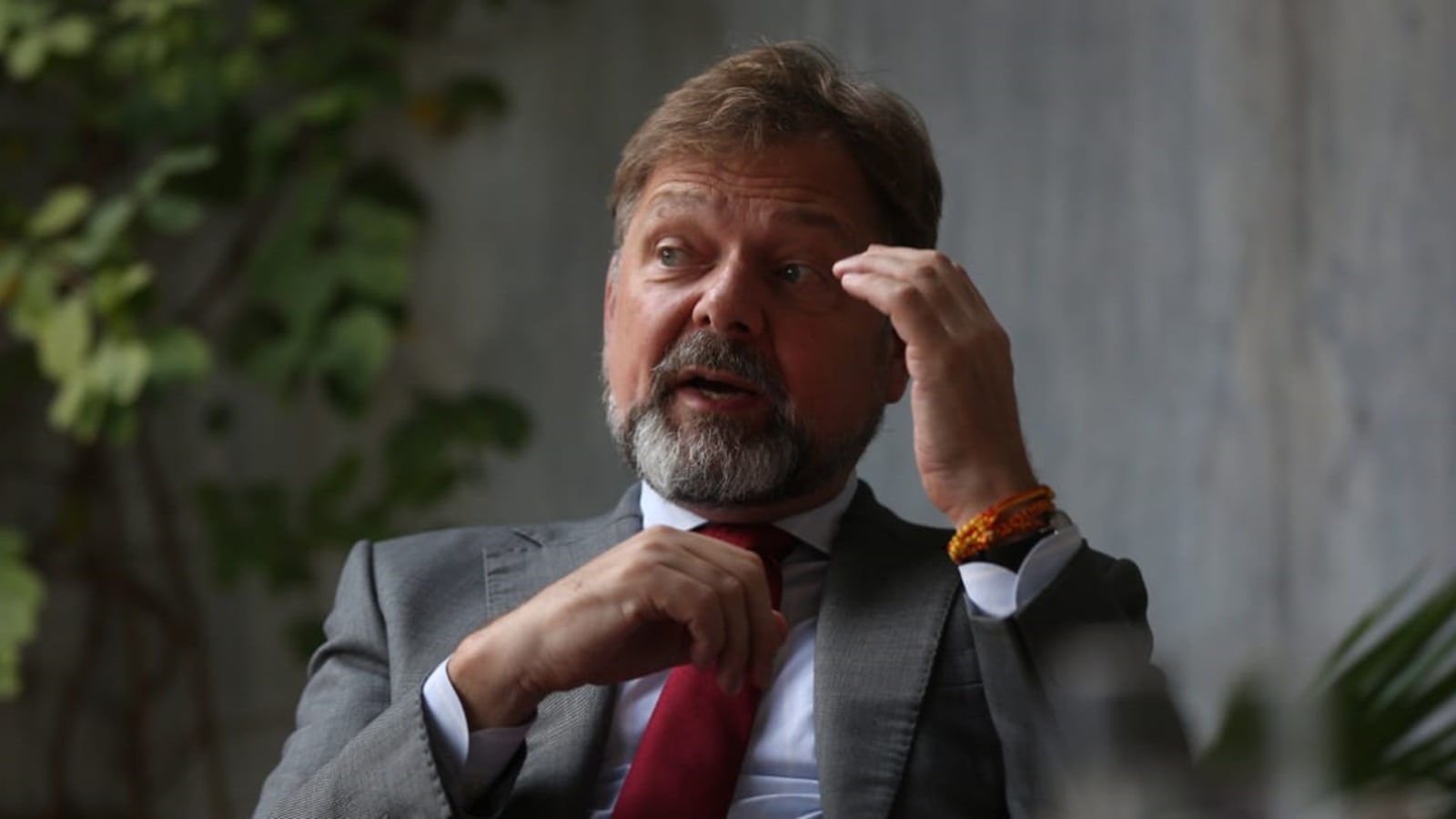
When he’s not building diplomatic relations and attending official events and meetings, Dr Philipp Ackermann has something else to keep him occupied — his love for art.
“As an art historian, you’re taught to watch everything very carefully. That’s the most important part of your training,” he says.
Ackermann, German Ambassador to India, studied Art History and Economics in Bonn, Heidelberg and Utrecht, and received his doctorate in art history in 1993.
Enthusiastically striding around his residence in Delhi’s Chanakyapuri, which is filled with artwork and sculptures, he says, “You see the floor here… The white marble on the ground. This.. is Makrana marble… the same one used in the Taj Mahal…”
“I tell my German guests who visit the residence that… you’re walking on the Taj Mahal. This has the same nuances of colour and many beautiful spots. You don’t get it in the market anymore,” he adds.
In the middle of his home is a beautiful Nataraja sculpture – a Chola period bronze sculpture – placed on top of a round black table.
“The German ambassador got this Nataraja as a present in 1955 from the Tamil Nadu CM. It was one of the first presents he got. It fits perfectly in the residence. It’s a copy of course… but it’s a beautiful piece,” says Ackermann.
Story continues below this ad
Next, he walks into a large room with a wall painted red. On it is a collage of black and white paintings made with water colour and pigment dust.
“I wanted to change some of the artworks that the German government has selected for the residence… We found a gallery in Gurgaon… and young Indian artists. They see the room and curate their own work here. Every six months, the room changes and we display work by different artists…”
As the German Embassy, set up in Delhi in 1956, marks 75 years of diplomatic relations between the two countries in 2026, The Indian Express spoke to Ackermann about the Indian artworks that spoke to him on a personal level and if art can strengthen diplomacy.
Excerpts:
What was the first piece of Indian art or architecture that spoke to you on a personal level?
Story continues below this ad
It’s very difficult to bring it down to one piece, but I would say the most stunning and breathtaking art I’ve seen in India is the Ajanta Caves.
Early Buddhist frescoes are very colourful, extremely moving, there is a lot of sensuality and storytelling in these murals in a way that you would not expect from Buddhism.
As for architecture… I find Humayun’s Tomb may be the most perfect piece of construction of architecture in India. It’s in these very clear forms and this abstract surface… and the play between marble and red sandstone is really unique.
I’m also a great admirer of South Indian sculptures, so early South Indian sculpture like Chola bronzes… the art of working with metal is very advanced, extremely fine and refined, and the aesthetics are beautiful.
Story continues below this ad
Have you found specific local art forms or a place where there is contemporary street art that offers a unique window into the life of Delhi?
There is such a rich culture of handicrafts and textiles in India. I sometimes go to Nature Bazaar, to the Dastkar, you know, and there are some shows and it’s always very interesting to see how these very skilled craftsmen open up to modern design. And it’s not static… and that I think is a good sign for a traditional handicraft.
There’s also one art which I particularly like… Warli art, the tribal art from Maharashtra, made by tribals who have a very strong bond with nature and they love birds.
These paintings basically cover more or less the world… You have all the activities in the village… agricultural life, you have the sun and the moon… It’s a very strong expression of art I feel.
Story continues below this ad
Are there any parallels or contrasts in Indian and European art movements?
I think I’m convinced, as an art historian, there is much more influence and exchange of artefacts between nations and civilisations than you think.
We tend to believe that civilisations develop on their own and stay with themselves for a long time, but the truth is that you have all sorts of influences across continents.
For instance, the Cholas went to Malaysia, they crossed the oceans and they brought home stuff. You go to Angkor Wat or Bali and you typically see Hindu temples. So, don’t make this mistake to think that civilisations are isolated.I will give you a nice example of the influence of European art on Indian art. You might be aware of this Srinath Pichwai culture. There was an old tradition of landscape printing in a geographic way. There is this three-dimensional idea of rivers, valleys, mountains and villages that you find in these pictures. And I find it to be a wonderful example of how arts get together and influence each other. This comes from a 17th century print from the Netherlands.
Story continues below this ad
If you had to recommend an overlooked art museum or gallery that is a must see for art visitors.
I want to just single out two museums which I really find stunning. One is the MAP museum in Bangalore. It is a small museum but they are doing great shows. It is a modern museum… with a lot of good insights in Indian popular art… not only classical art but also popular art…
The second, I would say – and that’s more of a classic museum, but it’s also top-notch and world-class – is the Bihar Museum in Patna. I think when you want to know about the coming into being of Indian art, whether it’s Hindu or Jain or Buddhist art, this is the place to go. They have beautiful artifacts…
Can art act as a way to strengthen diplomacy between two countries?
Story continues below this ad
I mean, some famous artists were diplomats. One of them is the Flemish painter Rubens, who was a diplomat. And I find it a very interesting thought, should diplomats be more artistic, should they have a certain artistic side to them. I think diplomats must have some empathy… you must see your counterparts in an empathetic way. Only then can you be a good diplomat. And I think the artist sees the world in an empathetic way. Maybe that’s a bit of a link to formulate.
What are you currently reading?
I read Anirudh Kanisetti’s History of the Chola Empire. It explains the early Middle Ages in South India, in a very day-to-day way… You get an idea of the system, of how the Chola and the population living under them worked, what role the temples and idols played along with what role the women played.
I’m also reading Arundhati Roy’s Mother Mary Comes to Me. It’s an excellent book… tells a lot about the 60s and 70s in Kerala, and the Christian community. So I thought it gives a very good insight into Indian society 50 to 60 years ago, and the problems families were facing then… you can see how much things have evolved.