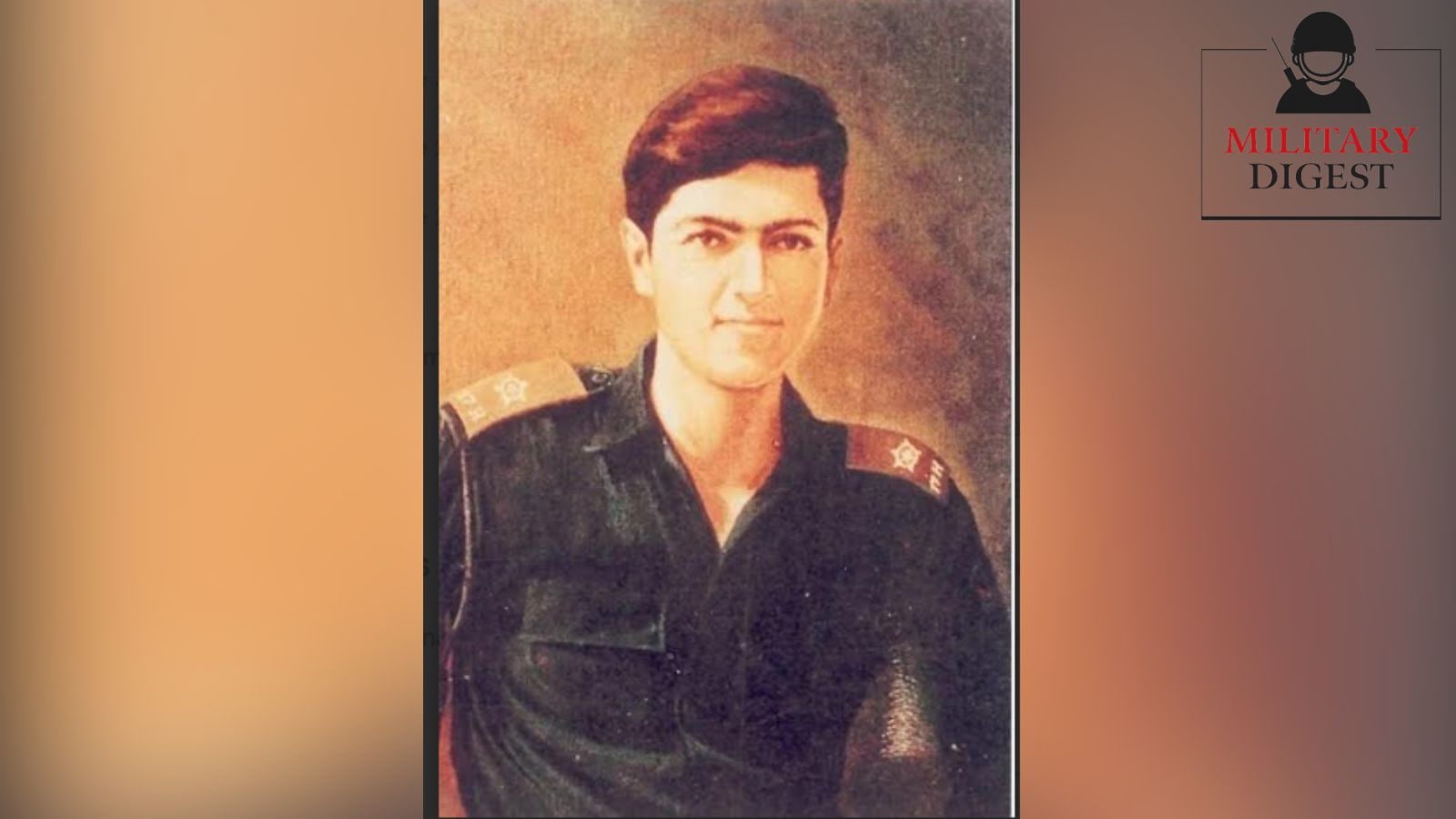
There is a poignant epitaph on the grave of a soldier in a World War 2 cemetery in Yangon, Myanmar. It says. “Had you known this boy of ours, you would have loved him too.”
It fittingly describes Second Lieutenant Arun Khetarpal, Param Vir Chakra (posthumous), too, who died in battle at the age of 21, a ‘boy’ officer embodying the highest traditions of the Indian Army. He is much loved for his sacrifice and would have been celebrated even more had he been alive today at 75.
The movie Ikkis, based on his life, has sparked much discussion on social media, and there has been an unfair comparison with another movie, Dhurandhar. There is much criticism regarding the pacifist theme of Ikkis. However, this does not diminish the brief but spectacular life of Khetarpal as both a boy and a soldier.
Khetarpal almost did not get to participate in the battles his regiment, the Poona Horse, fought during the 1971 war. In this week’s column, we will revisit his life and times in light of Ikkis.
Schooling and early life
Lawrence School, Sanawar, is situated on a hillock not far from the ridge where the tourist town and cantonment of Kasauli sprawl. The school’s motto, embossed right at the entrance, is hard to miss. ‘Never Give In’, it says with great emphasis.
It is said that the Battle of Waterloo was won on the playing fields of Eton. It can be safely assumed that it was in Sanawar that young Khetarpal picked up the stodgy, unyielding spirit of ‘Never Give in’ which made him stand like a rock between the attacking Pakistani tanks in the Battle of Basantar in December 1971.
Fellow students testify that beneath the quiet, friendly veneer of Khetarpal lay a stern character, tempered by the excellent curriculum mix of academics and physical training that Lawrence School made its students undergo. An excellent saxophone player, Khetarpal was also part of the school band. While in Sanawar, he had made up his mind to join the Army, and in June 1967, he joined the National Defence Academy (NDA) and was finally commissioned into the 17 Poona Horse in June 1971, just months before the war broke out.
Joining the Regiment
Story continues below this ad
Poona Horse is an old and distinguished regiment of the Indian Army and it won accolades in the 1965 Indo-Pak war just a few years earlier. The regiment had earned the title ‘Fakhr-e-Hind’ or ‘Pride of India’ from the enemy for its stellar performance on the battlefield during the attack on Sialkot in Pakistan Punjab. The Commanding Officer of the regiment, Lt Col Ardeshir Burzorji Tarapore, was awarded the highest gallantry award, Param Vir Chakra, posthumously.
The commanding officer of Poona Horse when Khetarpal joined the regiment was Lt Col (later Lt Gen) Hanut Singh, a stickler for discipline and already acquiring a persona that would make him a legend in the armoured corps.
Lt Col Hanut Singh made a critical decision that enabled Second Lieutenant Khetarpal to accompany his regiment into battle and, in turn, attain immortality in the annals of Indian military history.
The newly commissioned Second Lieutenant Khetarpal was familiarising himself with the day-to-day routine of the unit and with the troop of Centurion tanks (three tanks in one troop) that he was to command. A young officer’s life in the regiment is not an easy one, as he has to imbibe several important lessons which would enable him to command respect among the troops, many of whom would have more experience in the regiment than his age.
Obstacle of Young Officers course
Story continues below this ad
The entire episode of Khetarpal being detailed to attend a Young Officer’s (YOs) course at Ahmednagar, just when it was clear that war was on the horizon, has been narrated by Lt Gen Hanut Singh in an interview available on the YouTube channel ‘The Indian Soldier’.
In this excellent first-person account, Lt Gen Hanut Singh narrates how Khetarpal was ‘stunned’ by the news and pleaded with him to allow him to accompany the regiment into war. The following is the account of that episode as narrated by Lt Gen Hanut Singh some years before his demise.
A question people often ask is how a young and inexperienced officer like Arun, freshly out of the academy, managed to get himself enmeshed in the vortex of a major tank battle, the biggest tank battle the Indian Army has fought to this day.
When Arun joined, war clouds were already gathering, and it soon became clear that we would be drawn into an open battle with Pakistan.
Story continues below this ad
Just then, orders came for Arun to be sent for the Young Officers (YOs) course in Ahmednagar (in Maharashtra, home to the Armoured Corps Centre and School). The reason was that the academy only imparts basic military training. Officers on commissioning must complete the YOs course for their respective arms to be fit for command.
Until they complete this course, they are not capable of commanding basic sub-units. In keeping with this, Arun was told to proceed. He was stunned. He went into a deep depression. He finally mustered the courage and asked the Adjutant to arrange an interview with the CO.
In Lt Gen Hanut’s words, “When Arun was ushered into my office, I looked up and asked him, ‘Yes Arun’. He did not speak. Tears welled up in his eyes and he remained mum. I told him to sit down and compose himself. And when he was ready to tell me what his problem was, he did that.
He said, “Sir, the regiment is going to war. This is the opportunity of a lifetime. If I miss out now, I shall never see action again in my life. Please sir, take me off the YOs course. I give you my word that I shall make myself fit to command the troop and I will not let you down.”
Story continues below this ad
Hanut Singh said that when he saw the CO hesitate, he said, “Please, Sir, please, let me go with the regiment to battle.”
“I did not have the heart to deny him his wish. I knew if I said no, he would be heartbroken. So I sent it to the Adjutant and told him to take Arun off the course and run a mini YOs course in the regiment. Then I turned to Arun and said, ‘I will test you personally for this course and I shall give you command of a troop only if I think you are fit enough to do so. He looked at me with joy in his eyes and said ‘Sir, I will not let you down’,” he said.
After he had completed the training and the CO had tested him, he was satisfied he could command a troop in battle.
A lesser mortal may have found the YOs course to be a God sent opportunity to escape the rigours and dangers of the war, but for Arun Khetarpal, this was a matter of no choice. He reached forward and grabbed the opportunity to go to war with both hands and then ensured that he lived up to the promise he had made to his commanding officer by thwarting an enemy attack and inflicting serious damage on his tank forces at the cost of his life.
Former regimental officer recalls
Story continues below this ad
Lt Col HIS Dhaliwal (retd) was serving as OC Headquarters Squadron in the Battle of Basantar in Poona Horse. A decorated soldier, he had been awarded the Vir Chakra in the 1965 war. Dhaliwal recalls this episode, too.
“Yes, it is correct that Khetarpal had been nominated for the YOs course and he was very distraught about it. He requested permission from the CO to accompany the regiment to war. We were stationed in Sangrur at the time, and it was a matter of time before we would have been ordered to move into our concentration area, which eventually turned out to be near Samba under 47 Infantry Brigade,” he recalls.
Lt Gen Hanut’s tribute
In the video interview, Lt Gen Hanut ended his narrative on Khetarpal by quoting a verse from a poem Vitai Lampada by Henry Newbolt:
‘The sand of the field is sodden red,red with the blood of the square that brokeThe Gattling’s jammed and the colonel deadand the regiment blind by dust and smokeThe river of death has brimmed its banksAnd England’s far and honour a nameBut the voice of a school boy rallies the ranksPlay up! play up! and play the game!’
Story continues below this ad
“Khetarpal also was really a schoolboy with a solitary pip on his shoulder. But he did play the game, and he played it superbly well,” said Lt Gen Hanut.
Khetarpal’s remains were cremated in the field and his ashes were sent to his parents. His tank, Famagusta, named after a township in Cyprus where Poona Horse was once stationed, is now on display at the Armoured Corps Centre and School, Ahmednagar.
‘Never give in’
And so this story about this remarkable young soldier, who had just about turned 21 when he became immortal, ends where it started-Lawrence School, Sanawar. One can almost picture a teenager Arun Khetarpal running up the steep slopes of Sergeant Tilley’s hill at Sanawar singing these verses from the school song:
“Never give in Sanawarthough the wickets swiftly fallAnd the light is bad and our hearts are sadAnd it’s hard to see the ballNever Give in SanawarIt’s a cricket motto tooSomebody’s got to stop the rotAnd why not you.”