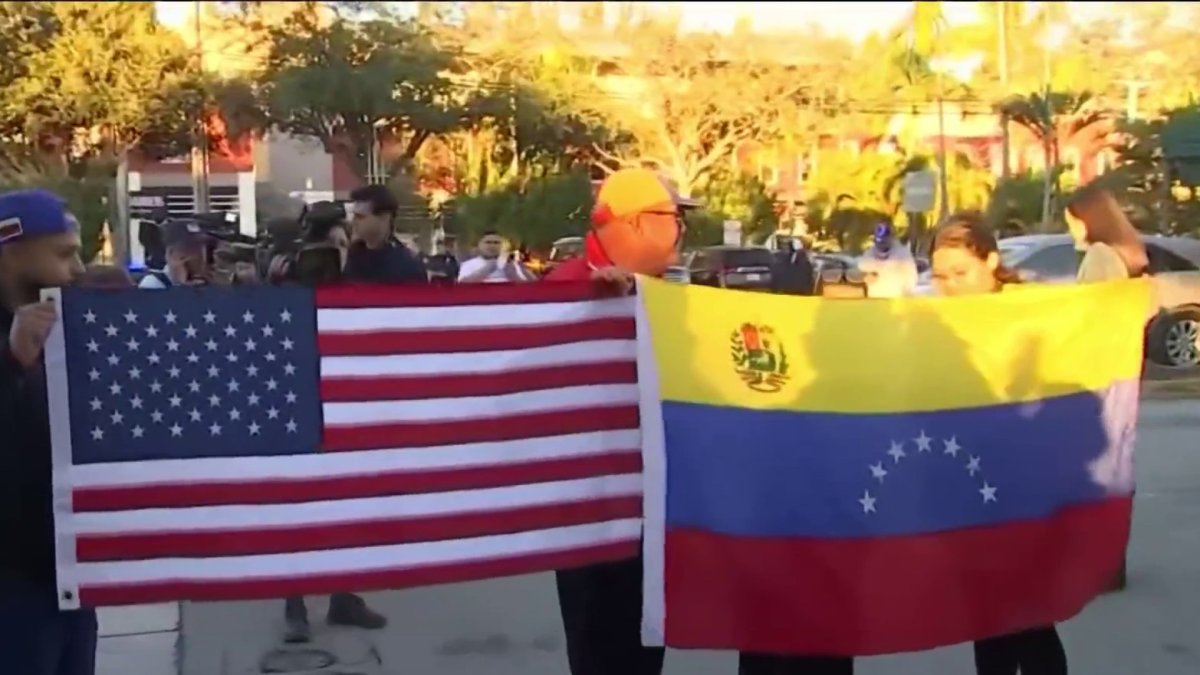
In the United States, there has been both condemnation and support after President Donald Trump confirmed U.S. military action in Venezuela and the arrest of that country’s president, Nicolas Maduro, and his wife.
In San Jose on Saturday, Venezuelan food truck hub Panas Parche hosted a celebration for what they called the fall of the narco-government. Owner Joel Silva, who came to the U.S. from Venezuela about a decade ago, said he was relieved to hear the news of Maduro’s capture.
“I am happy, I’m really excited,” he said. “Venezuela is free,” he continued.
Some people at the event talked to NBC Bay Area’s sister station, Telemundo 48, sharing what this means for them.
A woman said her family and friends suffered persecution in their native country, and that this is a step forward to democracy.
However, she also noted Maduro’s capture is just the first step, since a transition of power is still expected.
“All Venezuelans have been begging, praying for this to happen. There has been so many years of tragedies, so many deaths. The Venezuelan people don’t deserve everything we have gone through,” said Aida Crosby, a Venezuelan.
In Miami, dozens of people waved flags and chanted on Saturday.
“The last thing you lose is faith, and people have held onto the faith and hope that we were going to have a Venezuela that is free, it came today,” said Nicole Reinoso, a Doral, Florida council member.
But elsewhere, around the Bay Area and around the country, people gathered to protest America’s actions in Venezuela.
In San Francisco, one group gathered downtown at Market and Powell in protest.
“I can’t believe Trump has started yet another war for oil, so-called ‘America First,’ what’s America first about overthrowing another country? Whatever someone may feel about Maduro, there are processes,” said Howard Levitt of San Francisco.
An organizer with the Answer Coalition says San Francisco was one of more than 75 cities that held demonstrations against U.S. military action in Venezuela. Similar demonstrations were also scheduled for Santa Rosa and Santa Cruz on Saturday.
“We’re against war, and we need that funding to come here to our community. We need to lower the cost of living and have stronger public education,” said Sanika Mahjan, an organizer with the Answer coalition in San Francisco.
Friday morning, Trump announced the capture of Maduro and said the U.S. would run Venezuela at least temporarily until a transition of power could occur.
Trump also said Saturday that removing Maduro from power will open the door to Venezuela’s vast oil reserves.
“It could create a bit more supply for the world oil market,” shared Severin Borenstein, a Professor at U.C. Berkeley’s Haas School of Business and the faculty director at the Energy Institute at Haas.
But, Borenstein cautioned, that potential boost to supply needs to be taken in context. He expects that President Trump will ask U.S. oil companies to invest in Venezuela’s oil infrastructure. Borenstein has doubts about how much that will impact the prices Americans see.
“The idea that somehow the U.S consumer is going to get this oil and it’s going to make gasoline a lot cheaper is really not supported,” he said.
NBC Bay Area spoke with Nolan Higdon, a lecturer at UC Santa Cruz, about what might be next for Venezuela. He said it really depends on what the U.S. decides to do.
“If the United States does decide to engage in a military occupation and try to build a government, it’s going to Venezuela where it has some folks who are on the side of the United States and working with them, others who are opposed to it, and that’s going to force the United States to try to police the region and create stability,” he said.