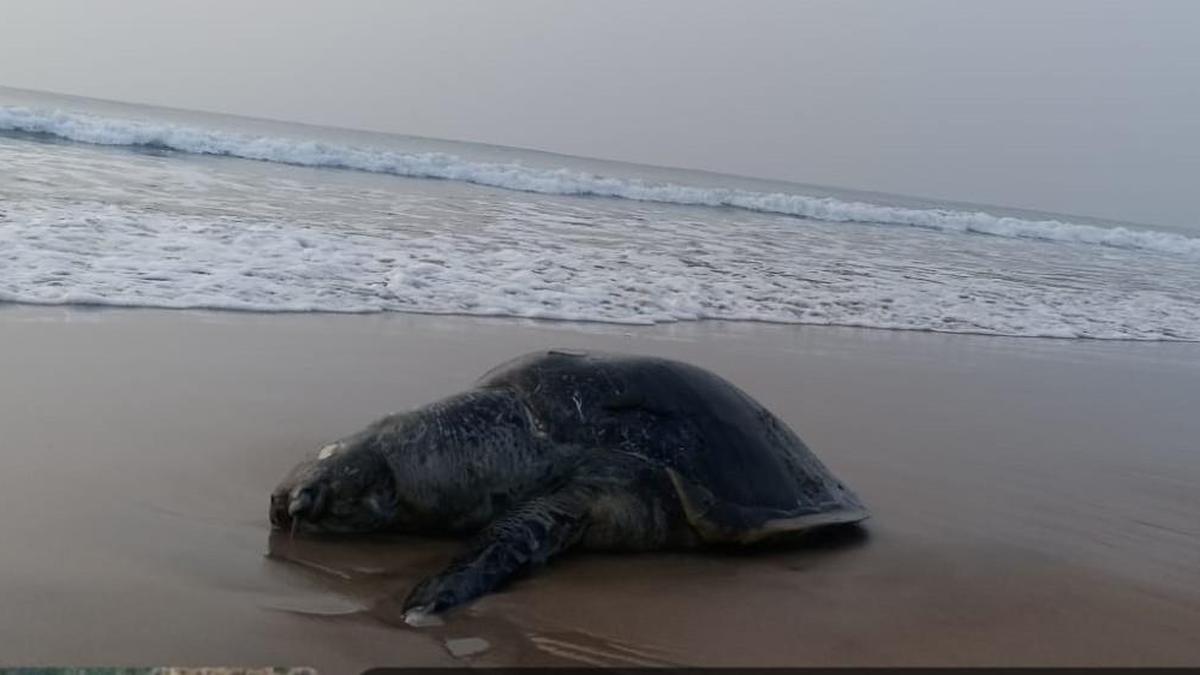
The carcass of an Olive ridley sea turtle on a beach in Visakhapatnam.
This year’s nesting season of olive ridley sea turtles is in full swing on the city’s beaches. However, the discovery of turtle carcasses on the shores has alarmed wildlife enthusiasts and conversationalists.
On Sunday (January 4) morning, the carcasses of three large olive ridley turtles washed ashore at Muthyalammapalem, Thantadi, and Rajanapalem beaches. It is believed the animals might have drowned after getting entangled in fishing nets, possibly while migrating. As per protocol, the Forest Department buried the carcasses in the sand.
Experts say that turtles need to surface for breathing every 40-45 minutes and can drown if caught in fishing nets. They called for stricter enforcement of the Andhra Pradesh Marine Fishing Regulation Act, including action against illegal fishing within 8 km off the coast.
With the Forest Department planning to create four nesting zones next week, concerns have been raised about the impact of artificial lighting along the Visakhapatnam coastline, particularly near RK Beach. Conservationists observed that most nests are found in darker areas between the Coastal Battery and the Novotel area and have suggested reducing bright nighttime lighting to create a more conducive nesting environment.
Speaking to The Hindu on Sunday, Visakhapatnam District Forest Officer Ravindra Dhama said: “We are collaborating with The Tree Foundation to run four hatcheries along the coast. Special precautions will be taken during the Visakha Utsav (January 23-31) to ensure that the nesting turtles are not disturbed.”
Andhra Pradesh coastline is a crucial breeding and nesting ground for olive ridley turtles (Lepidochelys olivacea), which are listed as ‘vulnerable’ by the International Union for Conservation of Nature (IUCN). The turtles typically nest along sandy beaches from December to April.
Nellore, Prakasam, Bapatla, Krishna and Godavari river mouths, Kakinada and the coastal districts of Anakapalli, Visakhapatnam, Vizianagaram and Srikakulam are considered crucial for nesting and hatching.
Conservationists believe that olive ridley turtles follow specific nesting patterns influenced by lunar cycles and tides. Female turtles typically come ashore during high tide, often crawling considerable distances before nesting. Observations suggest an erratic nesting pattern, with small numbers initially, followed by peak activity and a gradual decline, usually between November and March.
Published – January 04, 2026 07:17 pm IST